Drafted with AI tools and edited by a human. The figures and conclusions were checked by a GPUniq editor.
TL;DR
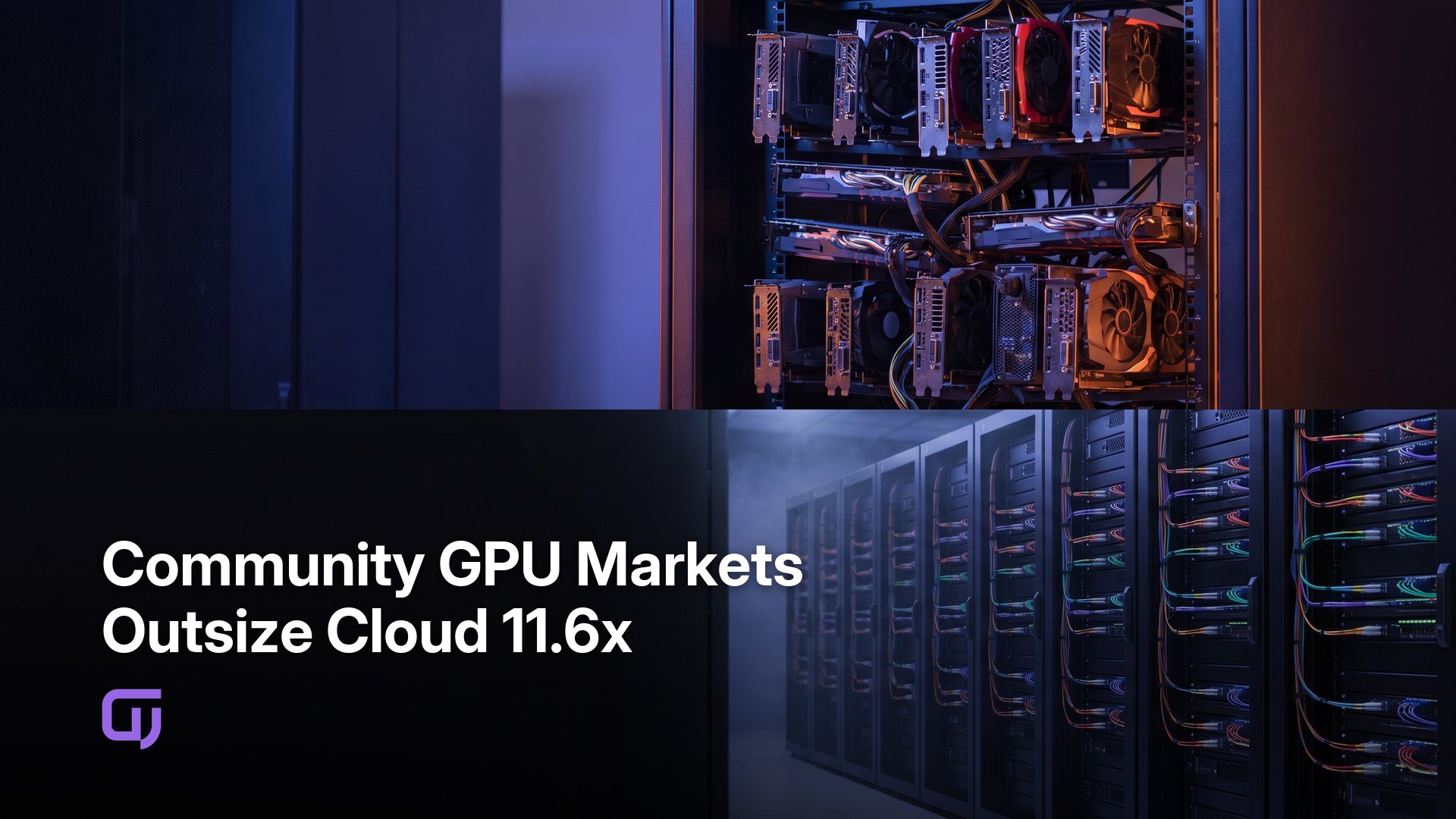
Community GPU marketplaces supply 11.6x more rental offers than cloud providers (6,402 vs 553), and achieve 40% real-time availability versus cloud's 30%. Cloud providers hold exclusive access to enterprise accelerators like the A100 SXM4 and RTX PRO 6000 Max-Q. The choice comes down to scale versus specialization.
Why does community supply dwarf cloud?
The math is simple: peer-to-peer networks aggregate miners, university labs, and small operators who list spare capacity whenever they have it. Cloud providers run consolidated infrastructure with SLA commitments and compliance overhead that limits how aggressively they can onboard new supply.
The audit counted 6,402 community offers versus 553 from cloud providers. That's an 11.6x gap. Cloud providers aren't trying to win on raw inventory count. They optimize for margin and guaranteed uptime, which means fewer fully-managed nodes rather than an open door for unvetted hardware.
The availability numbers make this concrete. Community platforms had 2,662 of 6,402 offers available at audit time (40%). Cloud had 186 of 553 (30%). Community hosts list capacity the moment it's free; cloud capacity often sits reserved or pre-allocated to enterprise contracts.
Which GPUs appear in both markets?
The RTX 4090, RTX 5090, RTX 3090, and RTX 5060 Ti show up in both channels. That's the tier where demand is high enough that individual hosts and cloud providers both find it worth listing.
Per-model pricing and availability counts are not available, so exact price spreads per GPU aren't comparable here.
If you need an RTX 4090 for inference or fine-tuning, you have options in both channels. The community side gives you more listings to compare.
What accelerators stay cloud-exclusive?
The A100 SXM4 and RTX PRO 6000 Max-Q appear only in cloud provider listings. You won't find a freelance miner listing either of these.
The reason is compliance. Enterprise accelerators come with support contracts, liability coverage, and certification requirements that individual hosts can't realistically meet. A lab running distributed training on A100 SXM4s needs guaranteed interconnect bandwidth, NVLink topology, and someone to call at 2am. Community platforms don't offer that.
On the community side, the Tesla V100 and RTX 3070 appear as community-only listings. Older data-center hardware like the V100 often ends up on peer-to-peer markets after enterprises retire it. Capable for inference and smaller training runs, but it won't satisfy an enterprise procurement checklist.
| GPU | Cloud | Community | Notes |
|---|---|---|---|
| RTX 5090 | Yes | Yes | Consumer flagship |
| RTX 4090 | Yes | Yes | Most common overlap |
| RTX 3090 | Yes | Yes | Older consumer tier |
| RTX 5060 Ti | Yes | Yes | Mid-range crossover |
| A100 SXM4 | Yes | No | Cloud-exclusive |
| RTX PRO 6000 Max-Q | Yes | No | Cloud-exclusive |
| RTX 3070 | No | Yes | Community-only |
| Tesla V100 | No | Yes | Community-only |
Geographic reach
The audit tracked community listings across 25 countries: AE, AR, AT, AU, BA, BD, BE, BG, BH, BR, BY, CA, CH, CL, CN, CO, CR, CZ, DE, DK, DZ, EE, EG, ES, and FI. Europe and North America dominate. Africa and South America are thin - Brazil and Algeria appear, but that's sparse continental coverage.
Cloud providers operate from defined regional zones with predictable latency. You know what you're getting. Community marketplaces require you to filter by location yourself, and the host you pick might be running on a residential connection.
For latency-sensitive inference, cloud's geographic predictability matters. For batch jobs or async workloads, a community host in a non-ideal region is usually fine.
The availability gap, precisely
Cloud: 186 available out of 553 total. That's 30%.
Community: 2,662 available out of 6,402 total. That's 40%.
The percentage gap is modest. What's more significant is the absolute number: 2,662 available community offers versus 186 cloud offers. You're far less likely to hit a "no capacity" wall on the community side. Cloud availability is also more volatile - a single large reservation can wipe out a regional pool.
Booking friction differs too. Cloud providers require account setup, billing verification, and sometimes quota requests for high-end GPUs. Community platforms are built for peer-to-peer rental with faster onboarding.
Community or cloud?
Go community if you need RTX 4090 or RTX 5090 capacity, want more listings to compare, and can tolerate variable support quality. The 11.6x inventory advantage and 40% availability rate mean you'll find something running quickly.
Go cloud if your workload requires an A100 SXM4 or RTX PRO 6000 Max-Q, or if you need enterprise SLA documentation, compliance records, or guaranteed uptime for a production training job. There's no community substitute for those requirements.
The hybrid approach makes sense for teams running both training and inference. Use cloud for long training runs where you need enterprise hardware and SLA guarantees. Use community for burst inference capacity or experimentation, where the RTX 4090 pool is deep.
All figures cover 6,955 total rental offers across both channels.
Related on the GPUniq blog
Methodology
'Cloud' is datacentre-hosted capacity, 'community' is independently hosted. Both are counted from the same GPUniq offer table at the same moment; availability is the share of offers rentable right then.
Sources
- 1.GPUniq marketplace statistics — GPUniq (accessed )
Want cheap GPUs for your next project?
Browse live GPU prices and rent the right card in seconds — H100, A100, RTX 4090, and 50+ more models.